Global Neurology Symposium 2026
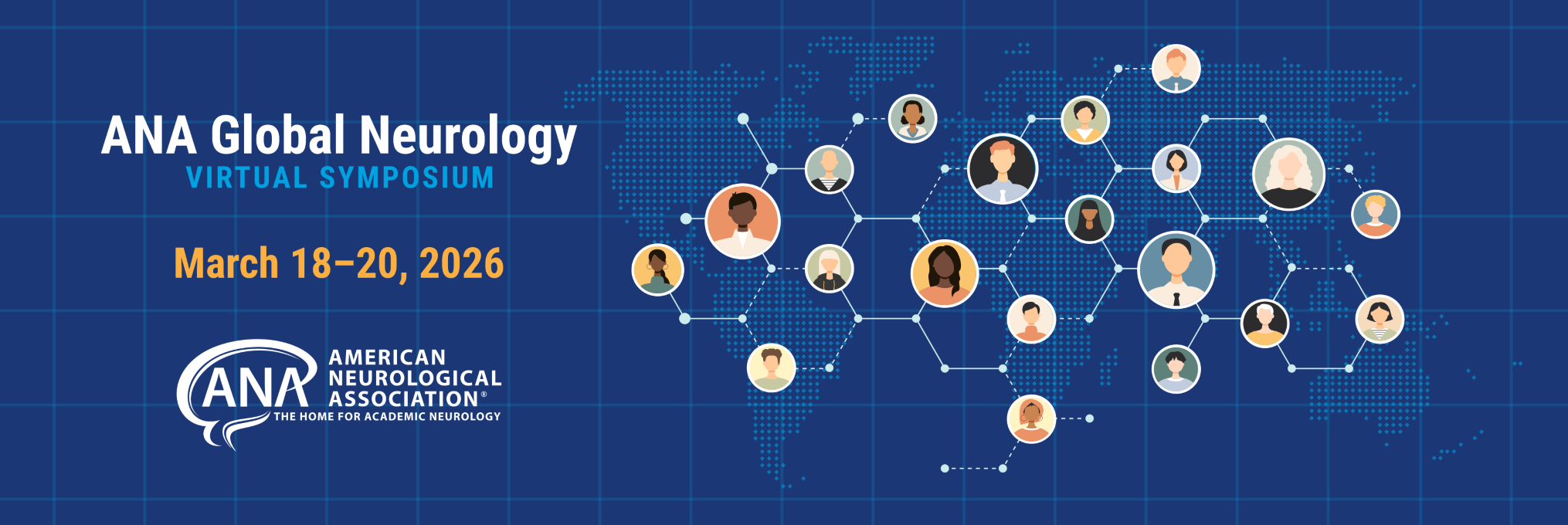
The ANA Global Engagement Committee has prepared an outstanding educational program for the ANA Global Neurology Virtual Symposium, taking place March 18–20, 2026. This annual event brings together neurologists, researchers, and trainees from around the world to share knowledge, foster collaboration, and explore global developments in neurology.
Day One is open to all ANA members and features a keynote address by Hector H. Garcia, MD, PhD, along with presentations from researchers in Low- and Middle-Income Countries (LMICs). Day Two is tailored for ANA members from LMICs*, with programming focused on research, writing, and funding in limited-resource settings.
Day Three offers a collaborative, interactive networking experience for all attendees. We have invited neurology organizations from around the world to join us for this special day. It will include disease-specific breakout rooms where attendees can connect directly with organization representatives and explore opportunities for partnership and collaboration within their subspecialty areas.
*Day Two is reserved for LMIC students, trainees, assistant professors, and instructors (or equivalent).
Schedule
Day 1: March 18, 2026 | 9:00–11:30 AM EDT
- Welcome
- Keynote Address by
Hugo Garcia, MD, PhD - Researcher Presentations
- Closing Remarks/Adjourn
Learning Objectives
At the conclusion of this activity, attendees will be able to:
- Discuss ongoing issues related to neurologic care and research Low- and Middle-Income Countries.
- Identify best practices to address gaps in neuroscience research capacity building in Low- and Middle-Income Countries.
- Develop a broad-based understanding of the practice of neurology in Low- and Middle-Income Countries.

Hugo Garcia, MD, PhD
Researcher, National Institute of Neurological Sciences
Director, Center for Global Health, Universidad Peruana Cayetano Heredia
Adjunct Professor, Johns Hopkins University School of Public Health
Dr. Hugo Garcia is a leading researcher in neurocysticercosis, a parasitic infection of the central nervous system caused by Taenia solium. His work has advanced treatment with albendazole and praziquantel, reducing the need for retreatment. He directed a 10-year cysticercosis elimination program in northern Peru and leads the Cysticercosis Working Group, a multi-institutional network that conducts research and provides hands-on global health training. Dr. Garcia has published over 250 peer-reviewed articles on cysticercosis and other public health topics in Peru.
Day 2: March 19, 2026 | 9:00 AM–12:15 PM EDT (Professional Development Day)*
*Day Two is reserved for LMIC students, trainees, assistant professors, and instructors (or equivalent).
- Getting Started: Conducting Research in Limited Resource Settings
- Writing Effective Manuscripts
- Funding Opportunities for Researchers in LMICs
- Adjourn
Learning Objectives
At the conclusion of this activity, attendees will be able to:
- Understand and apply technical writing skills to produce clear, logical, and grammatically correct scientific manuscripts.
- Describe the fundamentals of conducting neurological research in resource-limited settings.
- Identify funding opportunities for researchers in Low- and Middle-Income Countries.
Day 3: March 20, 2026 | 9:00 AM–12:00 PM EDT (Collaboration Day)
- Welcome
- Neurological Association Global Neurology Presentations
- American Neurological Association
- European Academy of Neurology
- World Federation of Neurology
- American Academy of Neurology
- Breakout Sessions*
- Dementia/Alzheimer’s Disease
- Epilepsy
- Movement Disorders/Parkinson’s Disease
- Stroke
*Breakout sessions will include presentations by leadership from the following organizations:
- American Epilepsy Society
- American Heart Association Stroke Council
- American Parkinson Disease Association
- Canadian League Against Epilepsy
- International League Against Epilepsy
- Research Dementia Latin America
Learning Objectives
At the conclusion of this activity, attendees will be able to:
- Identify opportunities for partnership and collaboration within disease-specific and subspecialty-focused neurology fields.
- Build professional connections and networks with representatives from global neurology organizations to support future interdisciplinary and cross-border collaboration.
- Develop strategies for sustained engagement with neurology organizations to advance advocacy, education, research, and patient-centered initiatives within their area of interest.
The American Neurological Association designates this live activity for a maximum of 5.25 AMA PRA Category 1 Creditsᵀᴹ. Physicians should claim only the credit commensurate with the extent of their participation in the activity.
The American Neurological Association is accredited by the Accreditation Council for Continuing Medical Education (ACCME) to provide continuing medical education for physicians.
